
Why the Room Itself Is Part of Your Audio System
Your speakers may be exceptional, but if your room works against them, you'll never hear what they're truly capable of. Every surface in a space—walls, floors, ceilings, glass, furniture—shapes the sound that reaches your ears. Understanding how sound behaves in a space is the first step toward correcting it, and the payoff is hearing your system perform at its best.
SEE ALSO: Why Outdoor Entertainment Is the Must-Have Upgrade for Every California Beach House
How Sound Reflections Undermine Audio Clarity
Sound waves bounce off hard surfaces and arrive at your ears milliseconds after the direct sound from your speakers. Those delayed reflections blur vocals, smear instrument separation, and make bass boom unnaturally, making audio that sounds muddy or fatiguing regardless of equipment quality. Open floor plans, hard floors, large windows, and smooth plaster walls are common contributors.
High ceilings compound the problem by dispersing sound upward, reducing presence at listening height. Late-arriving ceiling reflections create flutter echo—a rapid, repeating slap that distorts clarity and makes dialogue difficult to follow. They respond well to targeted solutions covered in the applications section below.
The Role of Materials: Hard vs. Soft Surfaces
The materials in your room determine how much sound energy gets reflected versus absorbed. Glass, tile, polished concrete, and smooth drywall reflect nearly all sound energy, creating a stack of reflections that muddy the listening experience. Upholstered furniture, area rugs, heavy curtains, and textured wall coverings absorb that energy and reduce reflections meaningfully.
The goal isn't a dead, over-dampened room, as too much absorption creates an unnatural, suffocating sound. The target is balance. Thick area rugs dramatically reduce floor reflections. Bookshelves with irregularly sized books act as natural diffusers, and heavy window treatments address glass reflection without sacrificing daylight.
Wood Finishes That Improve Acoustics Without Sacrificing Aesthetics
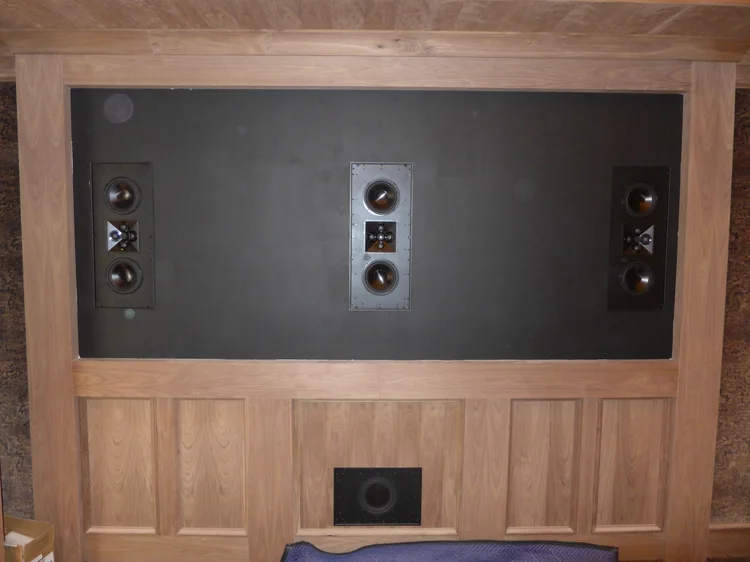
Acoustic treatment doesn't have to look clinical. Slatted wood panels, with vertical or horizontal slats and air gaps behind them, diffuse sound naturally while adding architectural warmth. Available in oak, walnut, and other premium finishes, they work beautifully on rear theater walls without announcing themselves as treatment.
Perforated wood panels take a more discreet approach, with micro-perforations allowing sound to pass through into absorptive backing while appearing as solid wood surfaces. Natural wood elements, such as live-edge panels and textured millwork, contribute to diffusion while serving as intentional design statements.
Where Acoustics Matter Most
Home theaters demand the most comprehensive treatment, requiring absorption on side walls, diffusion on the rear, and bass traps in corners for low-frequency control. High ceilings benefit from acoustic clouds. These are suspended horizontal panels that float above the listening area, intercepting ceiling reflections before they reach your ears without lowering the visual height of the space.
Media rooms need balanced treatment, with sufficient absorption to maintain clarity without deadening the room for conversation. Strategically chosen soft furnishings, area rugs, and wall treatments handle most reflection issues without a full acoustic buildout.
Listening rooms set the highest standard. Precision panel placement, asymmetrical diffusion, and careful speaker positioning combine to deliver reference-quality sound that reveals everything your system is capable of.
Sound Automation integrates acoustic design considerations into every home theater and listening room project. We consider room dimensions, surface materials, and speaker placement together—not as separate decisions. Our approach ensures your system performs the way it was designed to, in a space engineered to let it. Contact us today to set up a consultation.